Background
What is a Starshade?
A starshade is a large, petal-shaped spacecraft designed to work in tandem with a space telescope for the direct imaging of exoplanets. Acting as an external occulter, it flies in precise formation with the telescope, positioned tens of thousands of kilometers away, to block the bright light from a star while allowing the faint light from orbiting planets to reach the telescope’s aperture.
The starshade creates a shadow by suppressing starlight through diffraction. Its petal-like design diffracts light around the edges, producing a dark region where the telescope can observe. When aligned with a target star, the starshade reduces the star’s light by a factor of  to
to  as demonstrated in subscale tests, enabling the detection of planets that are billions of times fainter. The starshade can maintain this contrast over a broad wavelength range, from ultraviolet (UV) to near-infrared (NIR). Thereby allowing for the detection and characterization of planetary atmospheres, including the search for biosignatures such as water vapor (H₂O), oxygen (O₂), carbon dioxide (CO₂), methane (CH₄), and ozone (O₃). Furthermore, starlight is supppressed prior to light entering the telescope aperture, a starshade maintains a high level of optical throughput (close to or around 100%). In PyStarshade you can simulate throughput for different apertures.
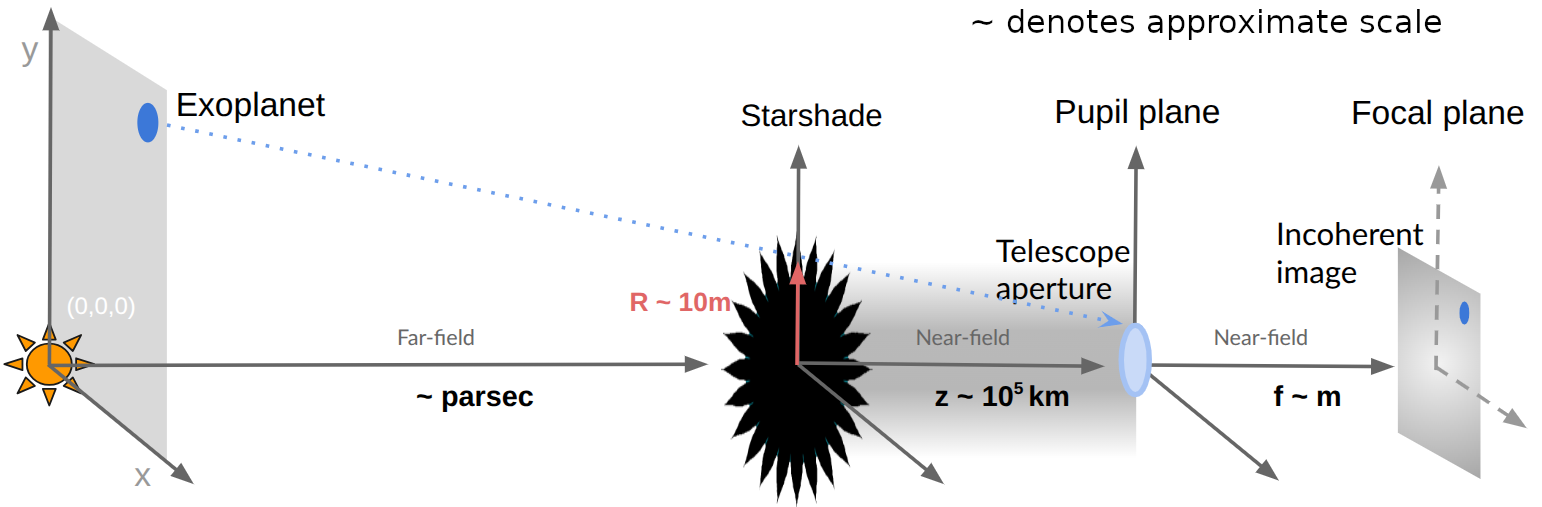
Caption: A starshade blocks starlight, casting a shadow on the telescope, allowing planet light to be imaged.
See [SSweb].
Optical Model Overview
PyStarshade is built upon a Fourier optics model that simulates the propagation of light from an exoplanetary scene through a starshade and telescope system. The model consists of two main stages of optical propagation:
Starshade to Telescope Aperture (Fresnel Diffraction): Light from the exoplanetary scene, modeled as a collection of point sources, propagates to the starshade. The starshade mask diffracts the on-axis light, and this diffracted field is calculated at the telescope aperture using Fresnel diffraction. For an on-axis source, the diffracted field at wavlength
 is
is  is computed as:
![f_{P,\lambda}^0[x, y] = \frac{e^{\frac{i\pi}{\lambda z}(x^2 + y^2)}}{\lambda z} \mathcal{F}\left( s[\zeta, \eta] e^{\frac{i\pi}{\lambda z}(\zeta^2 + \eta^2)} \right) \left[ \frac{x}{\lambda z}, \frac{y}{\lambda z} \right]](../_images/math/60e34ea870b41092206a5977bbdc85363a02b7db.svg)
where
![s[\zeta, \eta]](../_images/math/a1a54fe1e724c40ef9348f34c74d18c28aa701fd.svg) is the starshade mask, is the wavelength, and
is the starshade mask, is the wavelength, and  is the distance between the starshade and telescope. A starshade will diffract light for sources within an angular separation of the axis of approximately
  where
where  is the starshade radius and is the starshade-telescope flight distance.
Telescope Aperture to Focal Plane (Fraunhofer Diffraction): The diffracted field at the aperture is then propagated through the telescope’s optical system to the focal plane, where the point-spread function (PSF) is formed. The PSF
 for a source at position
  is given by:
![\psi^\lambda[x, y] = \left| \frac{e^{\frac{i\pi}{\lambda f}(x^2 + y^2)}}{j \lambda f} \mathcal{F}\left( f_{P,\lambda}[\zeta, \eta] \cdot P[\zeta, \eta] \right) \left[ \frac{x}{\lambda f}, \frac{y}{\lambda f} \right] \right|^2](../_images/math/1d5873168697332f2d3cab71361e1dc3abeadf6a.svg)
where
![P[\zeta, \eta]](../_images/math/c68b0ffa5d4da065bcc174d49293b2654e24a2d7.svg) is the telescope aperture function and
is the telescope aperture function and  is the focal length.
A starshade has a spatially and spectrally varying PSF. PyStarshade builds a basis of PSF’s which are used to simulate imaging for astrophysical scenes.
Bluesteins FFT
PyStarshade uses Bluesteins FFT to compute the optical propagation described above. When a starshade is aligned with a star, starlight is diffracted by the starshade  onto a telescope aperture described by the convolution of the starshade mask with a Fresnel kernel. For a starshade mask
  which is zero inside the mask and unity outside, at a wavelength and starshade-telescope distance , the field at the telescope aperture is
  (Eq (1)) and is related to the Fourier transform of the starshade mask multipled by a highly oscillatory chirp term.
(1)![f_{\lambda}[u, v] \propto \mathcal{F} \left( s(u, v) e^{\frac{j \pi (u^2 + v^2)}{\lambda z}} \right) \left[ \frac{x}{\lambda z}, \frac{y}{\lambda z} \right]](../_images/math/e9460d85cdf219caf3b70ee03d74656680203e51.svg)
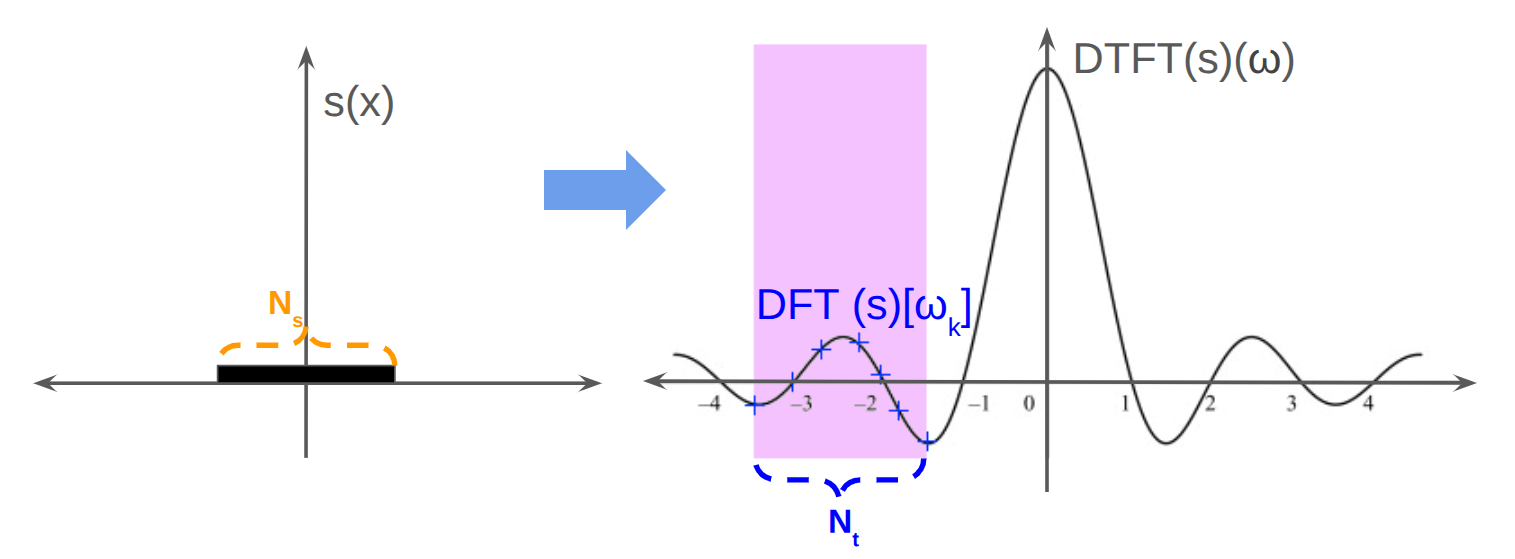
Numerical diffraction calculations must use a very small numerical resolution  of the starshade in order to accurately calculate starlight suppression without aliasing error. Using a standard FFT to perform these calculations is inefficient as very large zero-padding factors are needed to sample the field at the telescope aperture. The Bluestein FFT is a technique to calculate arbitrary spectral samples of a propagated field as illustrated below, indirectly using FFTs and therefore benefiting from their efficiency. For an
  starshade mask, and an
  telescope aperture, the Bluestein FFT approach achieves a complexity of
  . This technique is utilized in multiple aspects of the optical train to efficiently propagate fields.
Starshade Concepts
Habitable Worlds Observatory (HWO): Utilizes a 35 m diameter Starshade for UV observations or a 60 m diameter for broadband coverage, designed to achieve high-contrast imaging for exoEarth characterization [Shaklan2024].
Starshade Rendezvous Probe:A 26 m diameter Starshade designed to rendezvous with Romans 2.4 m telescope [StarshadeProbe2017] .
Earth-Orbiting Hybrids: Employs a large 100 m diameter Starshade in elliptical orbits, designed to collaborate with ground-based Extremely Large Telescopes for enhanced observations [Peretz2021].
Inflatable Starshade: An innovative concept exploring inflatable structures for Starshade deployment, aimed at reducing launch mass and complexity [NIAC2025].
Shaklan S. et al. 2024, SPIE, 13092, 130925D
Starshade Probe Report 2017, https://science.nasa.gov/wp-content/uploads/2023/04/Starshade2.pdf?emrc=c29363
Project Starshade: https://projectstarshade.com
S5 Website: https://exoplanets.nasa.gov/exep/technology/starshade/
Seager S. et al. 2015, SPIE, 9605, 96050W
Lisman P.D. and Schwieterman E.W. 2019, BAAS, 51, 217
Gaudi et al. 2020, arXiv:2001.06683
Peretz E. 2021, JATIS, 7, 021213
Inflatable Starshades for Earthlike Exoplanets NASA NIAC 2025 Phase I